Monday, October 25, 2010

WILT: Nociception

Today I learned about Nociception.  Never heard of it?  That's ok, neither had I...obviously.  However, before I go on, I have to say that this newfound knowledge led to one of the more romantic "things" I've recently learned.

Let's break it down.

Noci- comes from the Latin "Nocere," meaning: to injure (ever heard someone call an odor "noxious?")

-ception comes from the Latin "Capere," meaning: to receive (capisce?)


Therefore...Nociception refers to the function of the brain that receives pain.


This function occurs in "higher" species-those with complex nervous systems.  Science can pinpoint this in non-human animals by certain signifiers of pain: dilated pupils, increased pulse rate (raised blood pressure), perspiration, etc.

Some people can't feel pain, this is called CIPA (congenital insensitivity to pain and anhydrosis), they seldom live past age 25, for obvious reasons.
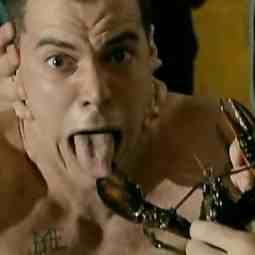


Now what on earth is romantic about this topic?

Nociception confirms the adage that says "it's all in your head."

The brain does not differentiate between physical and emotional distress.  This means that a broken arm triggers the same cognitive reaction as a broken heart.

Wednesday, October 20, 2010

WILT: Lesch-Nyhan Syndrome

Today I learned about Lesch-Nyhan Syndrome (Warning: not for the weak of stomach)


Lesche-Nyhan Syndrome, also called called Kelley Seegmiller Syndrome is a genetic disorder that results in the buildup of a specific kind of protein which leads to some very unique symptoms.

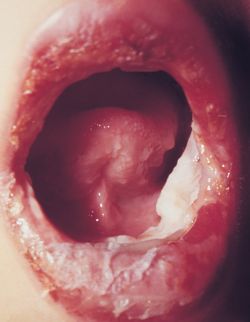
Aside from neural impariment, Lesche-Nhhan Syndrome can symptomatically sublimate in humans in the form of self mutilation starting at age 3.

This self mutilation usually begins with excessive biting of the lip.  (here's where it gets nasty)  There have been cases of Lesche-Hyhan Syndrome in which patients have literally chewed off their own lips.


In other news, I really hate image searching for medical disorders.

Wednesday, October 13, 2010

WILT: When Lightning Strikes

Today I learned what to do and how to predict when you're about to be struck by lightning.
(That is, if you happen to be at high altitude)


The first indicator of a lightning strike is sharp static shock, probably felt within your clothing because of, you guessed it, static electricity.

Next, you'll be able to smell the ozone building up in the atmosphere around you. When I asked my friend Peter (who was struck while climbing Mt. Adams) what ozone smells like, he responded, succinctly: "piss."

Finally (and this is the coolest part), you'll see "Napoleon's Glow," which is when anything metal nearby glows a shade of blue and sparks and jumps a little. When you see this, you've run out of time and hopefully have taken the following precautions:

  1. Get rid of all metal things! Quick!
  2. Spread out (if you're with other people) to avoid a splash charge (when the electromagnetic charge prefers to ground through you instead of a more resistant nearby object)
  3. Get into "lightning position," which, at high altitude means lying on your stomach and bracing your neck. Don't lay down if you're at ground level, instead do this:
and may the (non-electromagnetic) force be with you.

Thursday, October 7, 2010

WILT: Patriarch

Today I learned the etymology of the word Patriarch!

Turns out it's Greco-roman (appropriately, I might add) and comes from two words:


"Pater": Father
(think "paternity test," as in the audience's favorite segment of the Maury Povich show)

and

"Archi/Archon/Archein": To Rule 
(think "hierarchy" or "archdiocese," as in the old Catholic guys that tell people not to use condoms or hire sassy Vegas showgirls as nuns)

Monday, October 4, 2010

October the 4th, in the tenth year of the third millenium

This blog is firstly a semester-long assignment for my "Writing for the World Wide Web" class, and secondly a tribute to the end of my amazing ability to procrastinate on a project that I've meant to create for literally years.

Each post will be comprised of...you guessed it: what I learned that day.

We live in a global time, with the obscure knowledge of the world, once lost to locality, at our very fingertips.

The topics will be limitless-one day I might share what I learned in my academic endeavors as a Cultural Studies student. Another day it might be about some astrological phenomenon, and another day it could be about some long-forgotten bluegrass singer I discovered.

You get the idea, hope to see you again soon.